The Role of Academic Libraries in Diamond Open Access Book Publishing
This blog is part of a 7-part series produced within the LIBER Cascading Grants project, part of LIBER’s participation in Knowledge Rights 21.
By Iva Melinščak Zlodi (ORCID), University of Zagreb Faculty of Humanities and Social Sciences.
This blog is based on the report, “Embedding Open Access in Institutional Book Publishing Workflows: A Library-Led Diamond Model ,” available on Zenodo: Read the Full Report on Zenodo
Making a difference means seizing the right moment to engage, embedding support in existing workflows, adapting it to local contexts, and drawing on international best practices.
Why Diamond Open Access Books Matter
Croatia has a well-established non-commercial Open Access journal ecosystem, supported by national infrastructure and public funding. For scholarly books, however, the landscape is different. Books remain particularly important in the humanities and social sciences, but there is no comparable national Open Access infrastructure or funding model. National funding supports the publication of scholarly books without requiring Open Access, while agreements that cover Open Access publishing fees for journal articles have no equivalent for book processing charges.
Institutional and non-commercial publishing therefore plays an important role. Our earlier research into publicly funded scholarly books in Croatia found that Open Access books were published almost exclusively by non-commercial publishers, particularly universities, scholarly societies and public research organisations. At the same time, the infrastructure was fragmented, with many books simply made available through publishers’ websites rather than dedicated publishing platforms or repositories.
For the University of Zagreb Faculty of Humanities and Social Sciences (FFZG), where books are an important form of scholarly communication, developing institutional capacity for Diamond Open Access book publishing was a response to this context.
Building Infrastructure – And Trust
The FFZG Library established FF Open Press in 2018 and publicly launched it in 2019 as a Diamond Open Access platform for scholarly books. Over the following years, the Library continued to develop the infrastructure, publishing workflows and support for authors and editors, while Open Access was gradually incorporated into the Faculty’s publishing procedures. By September 2026, FF Open Press hosted 201 books.
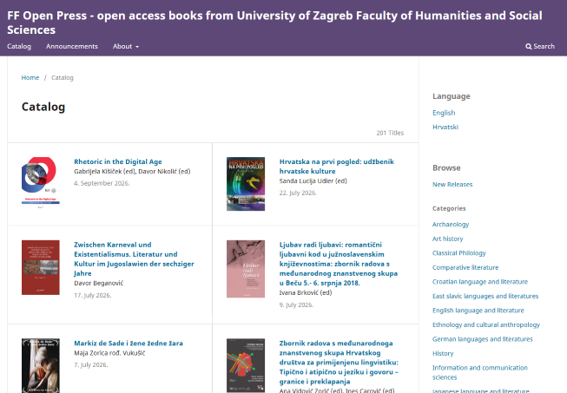
FF Open Press, the Diamond Open Access book publishing platform of the University of Zagreb Faculty of Humanities and Social Sciences.
Authors’ and editors’ interest grew alongside the platform. Some chose Open Access for new books, while others returned with older printed publications that they wanted to make openly available. The Faculty’s annual publishing plans provide another indication of this gradual change. In 2026, 69 of 72 submitted proposals included publication through FF Open Press. Of these, 21 planned an Open Access-only edition and 22 an Open Access-first edition, while 25 planned simultaneous print and Open Access publication. Only two proposals were for print-only books, and one planned Open Access publication through a co-publisher.
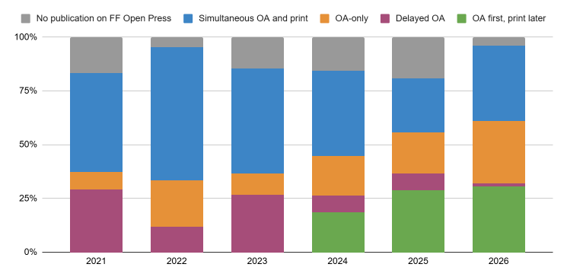
Planned publication models selected by authors and editors at FFZG, 2021–2026.
These figures do not measure trust directly, but the development over several years shows a growing willingness among authors and editors to include FF Open Press in their publishing plans. By 2026, the Library could build on infrastructure, expertise and relationships developed over several years.
Seizing the Right Moment
A new opportunity emerged when institutional funding for research projects brought Open Science more directly into research planning at the Faculty. Many funded projects included scholarly books or edited volumes among their planned outputs, bringing research funding, publishing choices and Open Access into closer connection. At the same time, the Faculty was reconsidering the relationship between Open Access and print within its publishing programme.
For the 2026 publishing plan, Open Access through FF Open Press was guaranteed for accepted titles following the prescribed workflow, while authors and editors seeking a print edition applied separately for print funding. This strengthened the position of Open Access as a starting point in the publishing process rather than an additional format considered at a later stage.
The LIBER/KR21 Cascading Grant came at this point in a longer process, providing an opportunity to consolidate existing practices, strengthen support for authors and editors, and document the evolving model.
Embedding Support in Existing Workflows
At FFZG, the aim was not to create a parallel Open Access publishing structure, but to integrate Library support more closely into existing publishing workflows.
FF Press, the Faculty’s publishing unit, remains responsible for editorial and production processes, particularly for print publications, while the Library manages FF Open Press and the digital Open Access editions. The Library is, however, increasingly involved at earlier stages, supporting authors and editors with copyright, Creative Commons licences, third-party material, metadata and persistent identifiers.
Individual consultations have been the principal form of support, allowing questions to be addressed in relation to particular publications. During the project, these were complemented by a workshop for authors and editors.
The questions arising through this work can be complex. A retrospective electronic edition of a collective work required permissions from numerous contributors and, in some cases, heirs of deceased authors. A foreign-language edition required separate clearance of illustrations and stock images and clearer identification of material not covered by the Creative Commons licence applied to the text. In another case, an agreement with a museum was needed for the reuse and licensing of reproductions.
These cases have practical consequences for the workflow. Rights and licences need to be considered early, different rights holders need to be identified, and licence information needs to distinguish clearly between the main text and third-party content. They have also shown that specialised copyright and licensing knowledge remains concentrated among a small number of Library staff. Documenting recurring solutions and sharing this expertise are therefore important for the sustainability of this support.
Bringing International Knowledge into Local Practice
Much of the expertise that enabled the Library to take on these roles was built through participation in international organisations, networks and projects such as OPERAS, DIAMAS, Knowledge Rights 21 and SPARC Europe. These connections have provided opportunities to develop knowledge of Diamond Open Access, copyright and licensing, scholarly publishing and wider developments in Open Science.
Applying this knowledge at institutional level requires attention to the local context. At FFZG, international experience has to work within an established publishing tradition, an existing division of responsibilities between the Library and FF Press, available institutional funding, and the particular needs of humanities and social sciences researchers. This has meant selecting and adapting approaches developed through international collaboration to address concrete needs within our own publishing environment.
FFZG is also one of five institutions involved in establishing the Croatian Centre for Diamond Open Access. The Centre provides a route for sharing experience developed at institutional level and contributing to wider national capacity building, including support for Diamond Open Access book publishing.
What Can Libraries Bring to the Process?
The FFZG experience illustrates several ways in which academic libraries can contribute to Diamond Open Access book publishing. Alongside infrastructure, they can provide expertise in Open Access, copyright and licensing, metadata and persistent identifiers; work directly with authors and editors; and draw on professional and Open Science networks beyond their own institutions.
At FFZG, this role developed gradually through investment in infrastructure, expertise and relationships. Changes in institutional funding and publishing procedures then created an opportunity to integrate it more firmly into the publishing process.
For libraries working in different institutional settings, the specific arrangements will necessarily differ. Our experience points instead to the importance of recognising opportunities for engagement, building support into existing workflows, developing solutions appropriate to the local publishing environment, and maintaining connections with the wider Open Science community.
About the Author
Iva Melinščak Zlodi is a senior scholarly communication and e-resources librarian at the University of Zagreb Faculty of Humanities and Social Sciences. Her work includes institutional repository development, support for electronic and Open Access publishing, electronic resources, information literacy, and bibliometric monitoring of research output. She is also Chair of the SPARC Europe Board of Directors.
About the Library
The Library of the University of Zagreb Faculty of Humanities and Social Sciences (FFZG) supports teaching, research and scholarly communication across a broad range of humanities and social science disciplines. Its Open Science and scholarly communication services include the institutional repository ODRAZ and FF Open Press, the Faculty’s Diamond Open Access platform for scholarly books.
LIBER Cascading Grants Collection