Passing on the Torch – Speech by Julien Roche, LIBER President 2022-2026
On 2 July 2026, Julien Roche, Director of Libraries and Learning Center at University of Lille, France, and LIBER President 2022-2026 gave his final speech as LIBER President and member of the Executive Board.
The speech was delivered during the Meeting of Participants 2026 in Trondheim, where LIBER members assemble to receive information and discuss current organisational matters. In his speech, Julien reflected on his time leading the Executive Board, developments and achievements of recent years, as well as the importance of LIBER’s shared mission. His speech marked the end of his Presidency term and 16 years in the LIBER Executive Board, as well as looks forward to LIBER’s continued work in the library and open science field.
You can read his speech below:
Dear colleagues, dear friends,
It is with some emotion that I address you today for the last time in my capacity as President of LIBER. In a few minutes’ time, I shall be passing on the torch, and it is fortunate, because it is time for others to trace the route. But before that, I wanted to take this opportunity to look back, through 16 years of involvement in our association’s governing bodies, in various roles, and through four years as President, on what we have achieved together.
I would first like to tell you of the pride and pleasure I have felt in having participated in, and subsequently presided over, the life and work of our association. LIBER is not the only association in our field; others are doing admirable work at every level. But LIBER, because it embodies a vision for building and sharing knowledge across our continent, is indispensable. This, indeed, was the driving force behind its founding 55 years ago. Pride, for sure, but pleasure, too, because I have had the privilege of meeting wonderful people, of being enriched by their company, and of growing professionally, thanks to them, thanks to you. I am very grateful to each and every one of you, both those who are still here and those who, sadly, have passed away but whom I have not forgotten.
Whilst preparing this speech, I asked myself: what have I contributed to our community during these years on the LIBER board, right up to my more recent years as our President?
Well, I would say, in all modesty, that these are the convictions that have underpinned our actions, and the achievements that have served those convictions. As I step down, I would like to share some thoughts with you. Of course, you already know much of what follows; you have been, are, or will be involved. It is to you that LIBER owes its vitality. It is your commitment to the benefit of our community that I wish to acknowledge here, through everything that is about to be said.
First of all, I have to acknowledge that we, librarians, build patiently – some may say we are even a little reserved.
I like to recall that libraries existed before universities, and that they are contemporary with and inherent in the first recording of knowledge in written forms. The quote from Bernard of Chartres, a 12th-century French philosopher and thinker, who is said to have stated – though the quote is probably apocryphal: “nos esse quasi nanos, gigantium humeris insidentes” – “we are like dwarfs sitting on the shoulders of giants” – well, this quote applies perfectly to who we are.
Libraries and librarians have, throughout history, played an important role not only in the preservation and dissemination of knowledge, but also in its creation. This is undoubtedly the first lesson I want to share with you: the need to take a long-term view of our policies and actions, looking beyond current events, passing trends and other “hypes”, and perhaps to cultivate a certain modesty and restraint in a world where points of reference are fading and unabashed excess has become the norm.
As a matter of fact, building patiently, with consistency and tenacity, is what we have done in every one of our initiatives.
Through open science, of course, which is certainly one of the great achievements of LIBER over the last decade and perhaps one of our most visible initiatives to the outside world. Libraries and librarians are now seen as champions of open science, and LIBER has contributed significantly to this undeniable success, through its Working Groups as well as its regular participation in European projects.
I am pleased to recall here that the first French national plan for open science was announced by the Minister for Higher Education and Research at the opening of our Annual Conference 2018.
We will, of course, need to continue our efforts, as there is still some way to go, and libraries will always need to be at the forefront, particularly at a time when public policies in favour of open science are getting weaker and when the commitment of academic communities is, unsurprisingly, becoming more fragile.
Other challenges also lie ahead, requiring us to redefine our priorities and, consequently, to rapidly develop and adapt our professional skills – a process that LIBER has been striving to support for several years through its continuing professional development programmes. The Leadership Seminar, launched in 2011 and now in its seventh cohort; the Journées, launched in 2015 and successfully held again a few weeks ago; and, more recently, a programme for middle management. All of these programmes share the same objective: to support managers and leaders in university and research libraries in an uncertain and rapidly changing world.
Rapid change, as I said: I believe that what best characterises our very contemporary world is this excessive and uncontrolled overrun of our society, which clashes with the reflective time that libraries have promoted ever since they came into existence. The clearest sign of this is with no doubt the sudden emergence of artificial intelligence in our personal lifes and professional practices – the subject of many hopes and fantasies, but also of many worries and fears.
AI has happened, and certainly not as a simple bubble that would collapse after a short period of time. Market capitalisation and massive fundraising, the organisation of energy sectors to meet enormous electricity needs, investment by public authorities – everything today suggests that this new technological advance, because it has become so widespread, is here to stay. We therefore need to adapt quickly, and LIBER has taken initiative after some initial delays and hesitations: AI will for sure play an important role in the coming years on the LIBER agenda.
Over the past decade, we have also come to realise the need to engage more effectively with society. It is a fact that the academia has long been largely impervious to, or even indifferent towards its wider environment, with academic communities often practising intellectual self-sufficiency and insularity, dragging libraries along in their blindness. Understanding that was a real shock and was accompanied by a sense of disbelief. The rise of misinformation and disinformation, as well as the growing lack of trust in science, coupled with the irresponsible and hateful use of social media in a Post-Truth world searching for meaning, have had a huge impact on academic communities. This major challenge is now recognised by university and research libraries, which have seized the citizen science topic as well as the need to counter misinformation and disinformation, capitalising on their reputation as neutral and trusted institutions within society.
But beyond that, we must draw all the necessary conclusions from this globalisation of the issues at stake, by developing a more ambitious advocacy strategy and better-organised lobbying activities. This is what LIBER has been working on for several years, but unsufficiently coordinated efforts have a limited scope, making it necessary to forge alliances whenever required. Natural alliances with other library and academic associations, with whom our lobbying efforts have been structured in recent years; alliances of convenience, less obvious, with other stakeholders who are only partially or loosely aligned with our vision: we have to take into account that public policies are neither scientifically grounded nor even rational; they are first and foremost the result of power dynamics and relations.
To conclude, I would like to look to the future with determination and lucidity. LIBER’s new strategy, which will come into effect in 2028, will undoubtedly provide an opportunity for us to work together to define the place and role of academic and research libraries within the European and the global landscape. In these difficult times for our institutions, with uncertainty surrounding the future of education and research, the decline of democracies and the resurgence of obscurantism, I invite you all to take action: while a future without libraries is not, in principle, impossible, I firmly believe that a future in which libraries and librarians continue to exist and fulfil their role will definitely lead to a better future and a better world.
Thanks for your attention, and long live LIBER !
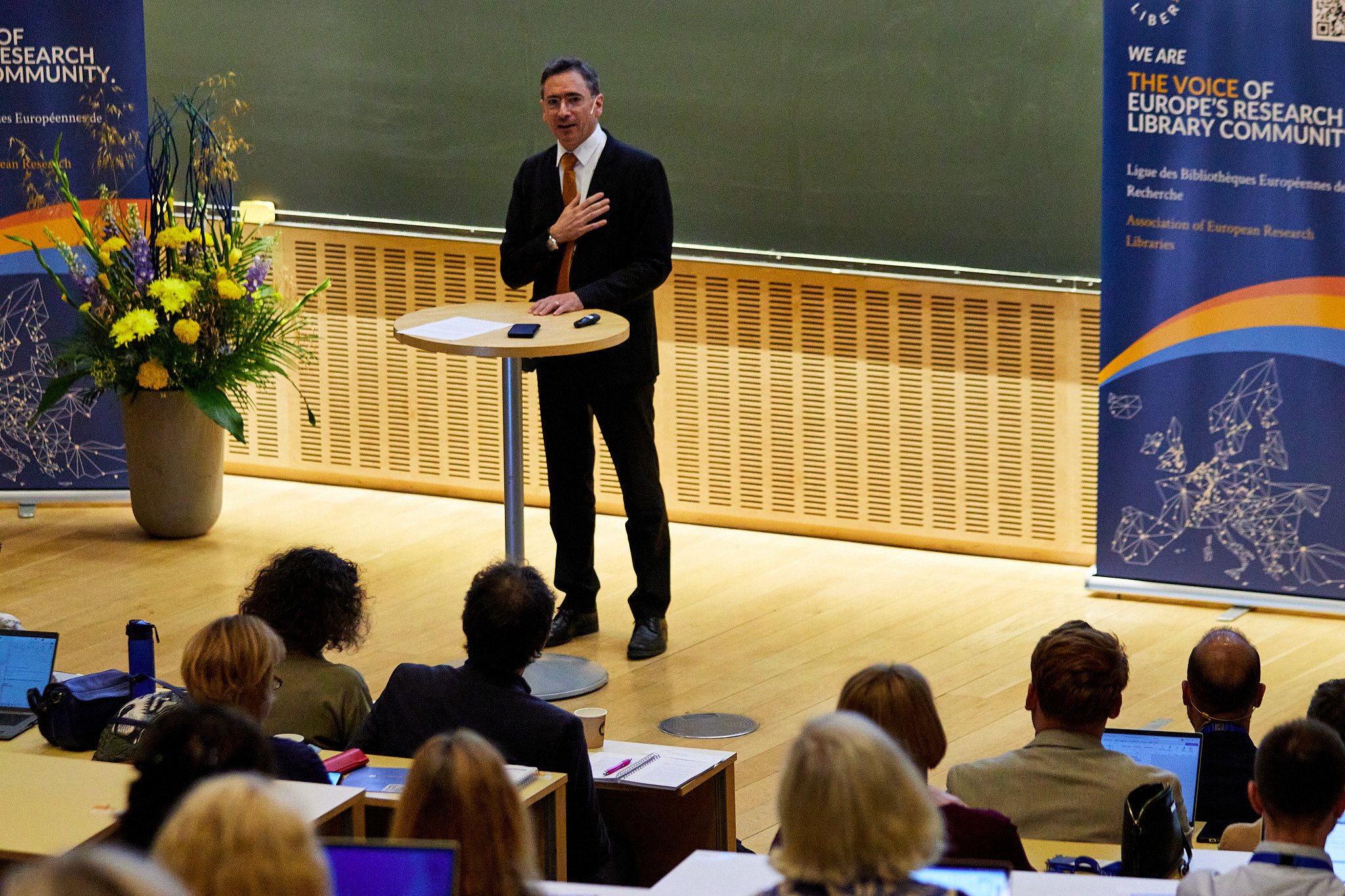
Photos captured by Krzysztof Kiersnowski / FotoSmil
Recent News