Sources about History of Bulgaria: Scaling Diamond Open Access for National Heritage and Secondary Digital Publishing
This blog is part of a 7-part series produced within the LIBER Cascading Grants project, part of LIBER’s participation in Knowledge Rights 21.
By Radostina Todorova, PhD, (ORCID) and Yuliana Stanimirova (ORCID), New Bulgarian University (NBU) Library
This blog is based on the report, “Sources about History of Bulgaria (Phase 2): Scaling Diamond Open Access for National Heritage and Secondary Digital Publishing,” available on Zenodo: Read the Full Report on Zenodo
Libraries across Bulgaria face a persistent legal and operational problem, as primary sources from the late 19th and early 20th centuries, as well as their reprints up to 1990, remain in a ‘grey area’ of copyright law. Fearing legal risks, many institutions apply a strict cut-off date for digitisation—1945—meaning that key parts of the historical heritage remain locked away within the walls of physical libraries. To address this issue, the New Bulgarian University Library launched Phase 2 of the ‘Sources about the History of Bulgaria’ project, funded by a LIBER Cascading Grant. By combining proactive legal mediation with modern digital workflows, the project has transformed the library from a passive custodian into an active secondary publisher following the ‘Diamond Open Access’ model.
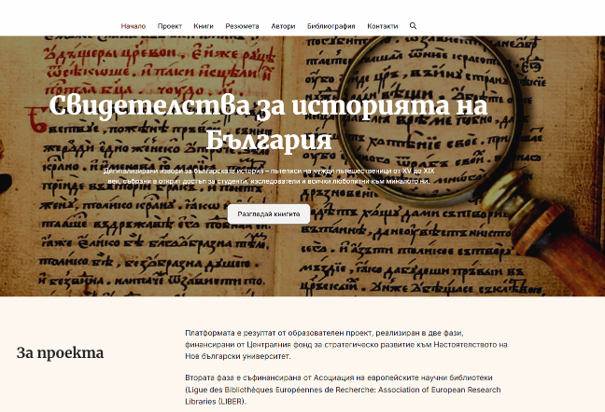
The initiative successfully digitised and published 12 foundational volumes of national memoirs—expanding the library’s multi-perspective Balkan digital collection (svidetelstvabg.nbu.bg) to 19 machine-readable volumes without fees for readers or authors.
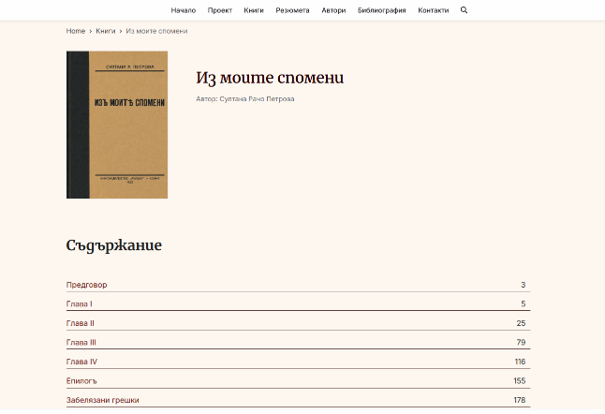
Instead of shying away from legal complexities, the NBU Library introduced a practical framework known as the ‘Copyright Detective’ model, aligned with transposed European legislation under Directive (EU) 2019/790 and Regulation (EU) No 386/2012. Rather than waiting for rights to expire, librarians actively tracked down living rights holders and secured signed, non-exclusive open access declarations. For out-of-commerce and orphan works, the library established an institutional routine for creating records on the EUIPO Out-of-Commerce Works Portal. Furthermore, to meet the needs of research, teaching, and library integration, each volume features permanent static URLs alongside chapter-level structural segmentation for direct integration into learning management systems like Moodle.
Building a secondary publishing infrastructure revealed both legal and technical hurdles. Many 20th-century critical editions were produced by state publishers that vanished post-1989, forcing librarians to develop new skills and act as rights detectives to locate individual heirs and negotiate open access permissions. On the technical side, statistical web analytics from the pilot phase was inadvertently lost during a platform modernisation, highlighting a crucial lesson for the library community: digital platform redesigns must embed data retention and analytics preservation protocols into their initial planning phase.
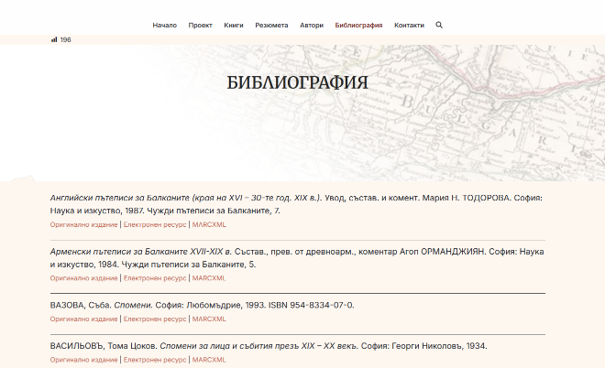
For institutions wishing to launch a library-led publishing initiative based on the ‘Diamond Open Access’ model, our experience suggests several actionable principles. Libraries must act as active legal intermediaries rather than settling for arbitrary historical cut-off dates, leveraging European out-of-commerce mechanisms and engaging in direct collaboration with rights holders. To maximise impact, the project provides standardised records in MARC21 and MARCxml formats, enabling academic and regional libraries to import these primary sources directly into their local OPAC catalogues. Transforming librarians into digital curators, copyright specialists, and metadata creators significantly strengthens institutional capacity, directly aligning with Pillar 3 of LIBER’s 35-Point Action Plan.
For the NBU Library, LIBER’s support highlights the significance of the project for research libraries across the Balkans and Europe. Through this dedicated blog post and our upcoming dissemination webinar, Improving Open Access Practices in European Research Libraries (4 November 2026), we share our operational experience to encourage the active research use and re-use of the portal (svidetelstvabg.nbu.bg) by the European research library community.
LIBER Cascading Grants Collection