This blog is part of a 7-part series produced within the LIBER Cascading Grants project, part of LIBER’s participation in Knowledge Rights 21.
By Jerneja Grašič; Sara Bračun; Bernarda Korez (ORCID), University of Maribor Library.
This blog is based on the report, “Enabling Responsible Open Publishing,” available on Zenodo: Read the Full Report on Zenodo
As part of the LIBER Cascading Grants programme, the University of Maribor Library developed an adaptable framework to help scholarly journal editorial teams translate open science principles into clear policies and day-to-day editorial workflows.
Open Access Alone Does Not Ensure Transparency
Since 2016, journals previously published by individual faculties have gradually joined the University of Maribor Press. Their different institutional and disciplinary histories may partly explain the variation in editorial practices and policies that we found in our review. Although all are open access, information on licensing, copyright, research data, peer review and post-publication procedures was often scattered across different parts of their websites or, in some cases, was not explained clearly enough.
A similar challenge emerged in our practical work with the Portal of Slovenian Scientific Journals and Monographs and our institutional repository DKUM (both developed by LHRS at the University of Maribor Faculty of Electrical Engineering and Computer Science). When information on journal websites or in the articles themselves is not presented clearly and consistently, this is also reflected in the metadata imported into the discovery service, repository and other connected information systems. This can lead to less complete and consistent metadata, unclear reuse conditions and reduced discoverability of scholarly content. The Enabling Responsible Open Publishing project therefore grew out of a simple question: how can we provide editorial teams with a practical framework that clearly sets out what information journals should communicate publicly and how it should be presented, while remaining flexible enough to accommodate differences across disciplines, editorial workflows and publishing models?
The project supports the objectives of the LIBER Action Plan in the areas of open access, clear licensing practices, copyright, research data, and practical training and support.
A Template That Explains Not Only What, but Why
The first draft was a short collection of model text covering open access, the use of Creative Commons licences, the handling of research data, author declarations and article retractions. As we reviewed it, we realised that individual provisions alone did not yet form a coherent and practical framework. We therefore gradually developed the document into a comprehensive publishing policy template.
In developing the framework, we drew on applicable Slovenian legislation and institutional rules, together with national and international recommendations and good practices in open science, research integrity and responsible scholarly publishing.
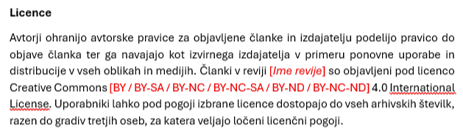
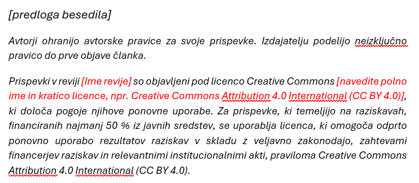
Figure 2 English translation*:
[text template]
Authors retain copyright for their contributions. They grant the publisher a non-exclusive right of first publication of the article.
Contributions to the journal [Name of journal] are published under the Creative Commons license [provide full name and abbreviation of the license, e.g. Creative Commons Attribution 4.0 International (CC BY 4.0)], which sets out the terms of their reuse. Contributions based on research funded at least 50% by public funds are subject to a license that allows for the open reuse of research results in accordance with applicable law, the requirements of research funders and relevant institutional acts, as a rule, Creative Commons Attribution 4.0 International (CC BY 4.0).
A key feature of the template is its two-part structure. In most chapters, the first part provides internal guidance for editorial teams: it explains the purpose of the provisions, highlights decisions to be made by the editorial board, and points to relevant national and international resources. The second part contains model text that the editorial team can publish on the journal website after reviewing it, selecting the appropriate options and adding the relevant journal-specific information.
This structure proved important because it is not enough simply to tell editorial teams what they need to do. They also need to understand why a particular practice matters and how to apply it. For research data, this means placing data availability statements in the context of the FAIR principles, trusted repositories, and relevant legal and ethical constraints. For text similarity checking, it means making clear that the similarity score shown in the report is not in itself evidence of plagiarism and must be interpreted using informed editorial judgement rather than treated as an automatic determination.
Pilot Implementation – Lessons Learned
We tested the practical usability of the template in collaboration with the editorial teams of the Journal of Elementary Education (Revija za elementarno izobraževanje) and the Journal of Energy Technology. The two journals started from different positions: the first had relatively little information about its publishing policies available on its website, while the second already had basic policies on research data, artificial intelligence and copyright. Both editorial teams reviewed the template, selected the provisions and options applicable to their journals, and added the necessary journal-specific information. Whenever questions or uncertainties arose, they contacted our project team.
The questions raised by the editorial teams showed us where support was most needed. We clarified the difference between free-to-read access and open access, the characteristics of Diamond Open Access, secondary publishing, and the licensing status of older archival content. In particular, a journal’s current licence cannot automatically be applied to articles published before that licence was introduced unless there is an appropriate legal basis for doing so.
The pilot implementation also revealed technical challenges. When we initially placed the publishing policy of the Journal of Elementary Education under the “About the Journal” section, the long drop-down menu made the policy difficult to find. We therefore created a separate “Publishing Policy” section in the main navigation menu. As OJS does not provide a clear way of displaying a third level of hierarchy, we also had to adapt the original chapter structure. Longer sections were organised into collapsible sections, key information was highlighted, and related chapters were cross-linked. We used ChatGPT as a support tool for the technical formatting, but always reviewed and, where necessary, corrected the generated code before implementing it in the system.
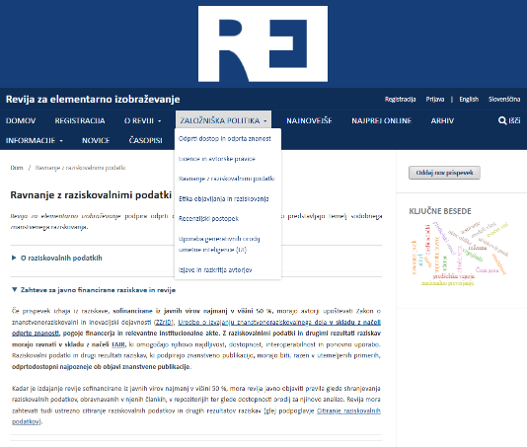
The experience confirmed that a good policy cannot simply exist as a document. It needs to fit actual editorial workflows, be understandable to users, and be presented effectively on the publishing platform in use.
From a Pilot to a Broader Framework
During the project, we developed both a comprehensive and an abridged version of the template, worked with two editorial teams, and carried out a pilot implementation on the website of the Journal of Elementary Education. The publishing policy for the Journal of Energy Technology has been completed in terms of content but still requires translation into English before publication. This translation work will also enable us to prepare an English-language version of the policy for the bilingual website of the Journal of Elementary Education.
Our next goal is to gradually introduce the framework across other journals published by the University of Maribor Press and to continue providing training for editorial teams. At a later stage, it could also be presented at the national level as a basis for greater consistency in terminology and clearer communication of publishing practices, rather than as a single fixed policy for all journals. The framework could also be adapted for scholarly monographs.
A longer-term opportunity lies in better integration of publishing, repository and bibliographic systems. If high-quality metadata could be created and curated once and then transferred in a controlled way between connected systems, this could reduce duplication of work and improve the consistency of records.
Acknowledgements
We are grateful to the Editor-in-Chief of the University of Maribor Press, the Director of the University of Maribor Press, and the editorial teams of the two pilot journals for their collaboration, valuable feedback and support throughout the project.
*Translation notice: This text has been automatically translated. In the event of any discrepancies, the original-language version shall prevail.
LIBER Cascading Grants Collection